


24 Dec, 2025
The Ultimate Garage Door Maintenance Guide: How to Keep Your System Quiet, Safe, and Reliable
A garage door is likely the heaviest moving object in your home or business. It operates under massive tension, cycling up and down thousands of times a year. Yet, for most people, it is “out of sight, out of mind” until a spring snaps at 7:00 AM or the door refuses to close during a storm.
Preventative maintenance is the difference between a door that lasts 20 years and one that fails in five. It is also the key to silence. That screeching, grinding noise isn’t just an annoyance; it is the sound of metal grinding itself down.
At The SGD Group, we see the full lifecycle of a garage door. Our manufacturing division, SGD Springs, builds components to withstand rigorous cycles. Our service teams at Superior Garage Door (MN) and Supreme Garage Door (TX) repair systems that failed due to neglect. This guide combines that manufacturing and service expertise into a comprehensive maintenance plan for homeowners, facility managers, and contractors.
The Cost of Neglect: Why Maintenance Matters
ignoring a garage door doesn’t save money; it defers cost with interest. Small issues, like a dry roller or a loose hinge, put extra drag on the opener. Over time, this friction strips the plastic gears in the opener or causes the motor to burn out. Worse, a door that binds or drags puts uneven stress on the torsion springs, significantly shortening their lifespan.
For commercial facilities, the stakes are higher. A stuck door in a warehouse or loading dock means downtime, security risks, and lost revenue. A simple quarterly maintenance routine can prevent emergency service calls that disrupt operations.
The “Look and Listen” Inspection
You don’t need to be a certified technician to spot early warning signs. We recommend a monthly “Look and Listen” inspection.
1. The Listening Test Stand in the garage and close the door. Is there a scraping sound? That could be a frayed cable rubbing against a drum. Is there a loud popping noise? That might be a door section binding as it turns the radius of the track. Is there a high-pitched squeak? That is usually a lack of lubrication on steel rollers.
2. The Visual Scan
-
Cables: Look at the steel cables lifting the door. Warning: Never touch them. Just look. If you see fraying, rust, or loose strands, call a professional immediately. These cables hold the full weight of the door.
-
Rollers: Inspect the wheels running in the track. If they are nylon, look for cracks or chips. If they are steel, look for “wobbly” bearings.
-
Springs: Look at the torsion spring above the door. Is there a gap in the coils? If so, the spring is broken, and the door will not open.
-
Hardware: Check the hinges that hold the panels together. Vibration often loosens the bolts. If you see a loose screw, tighten it—but be careful not to over-tighten and strip the hole.
The Secret to Silence: Proper Lubrication
Lubrication is the single most effective maintenance task a homeowner can do. It takes ten minutes and can make a noisy door whisper-quiet. However, using the wrong product does more harm than good.
The Golden Rule: Never use WD-40 or heavy grease. Standard WD-40 is a solvent (Water Displacement), not a long-term lubricant. It cleans rust but eventually dries out and attracts dust, creating a gritty paste that wears out bearings. Heavy grease (like axle grease) is too thick; in winter, it hardens and gums up the track, causing the door to drag.
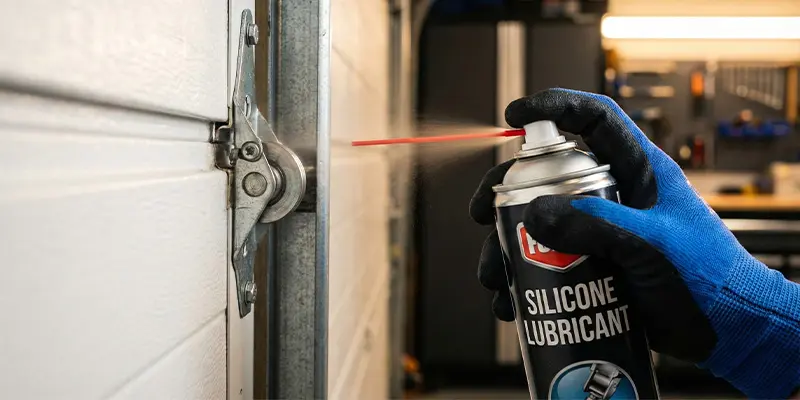
The Right Stuff: Use a Lithium-based spray or a specialized Garage Door Silicone Spray. These sprays coat the metal without attracting dirt and remain viscous in both freezing Minnesota winters and scorching Texas summers.
Where to Spray:
-
Springs: The coils rub against each other every time the door moves. Coat the entire length of the torsion spring. This reduces friction and prevents the spring from binding and “popping.”
-
Rollers: If you have steel rollers, spray the ball bearings inside the wheel. If you have nylon rollers, only spray the steel stem that slides into the hinge. Never spray the nylon wheel itself, as it can cause it to slide rather than roll.
-
Hinges: Spray the pivot points where the hinge bends.
-
Bearings: There are bearings at the end of the torsion tube and in the center. Give them a quick spray.
What NOT to Spray: Do not lubricate the tracks. The tracks should be clean and dry. Adding oil to the tracks causes the rollers to slip and gathers dust, which creates bumps in the travel. Wipe the tracks clean with a rag and brake cleaner if they are dirty.
Safety Testing: protecting What Matters
Modern garage doors are equipped with safety features designed to prevent injury and property damage. These systems must be tested regularly.
1. The Photo-Eye Sensor Test Every opener manufactured after 1993 has two sensors near the floor—one sending a beam, one receiving it.
-
The Test: Push the button to close the door. While it is moving down, wave a broomstick or roll a ball through the invisible beam.
-
The Result: The door should immediately stop and reverse to the open position, often flashing the lights. If the door keeps closing, the sensors are misaligned or faulty.
2. The Auto-Reverse Force Test This tests the opener’s internal sensitivity.
-
The Test: Place a 2×4 piece of wood flat on the ground in the center of the opening. Close the door.
-
The Result: When the door touches the wood, it should detect the resistance and immediately reverse. If it pushes hard against the wood without stopping, the force limit settings on the opener need adjustment.
When to Call the Professionals: The Tune-Up
While lubrication and observation are great DIY tasks, true garage door maintenance requires a trained eye. Torsion springs, cables, and bottom brackets are under extreme tension and can cause severe injury if mishandled.
A professional tune-up from Superior Garage Door or Supreme Garage Door includes tasks that homeowners should not attempt:
-
Spring Balancing: Over time, springs lose tension (relax). A technician will check the door’s balance (it should be weightless at waist height) and add the precise amount of tension to the springs to restore perfect balance.
-
Track Alignment: If the vertical tracks are too tight against the door, it causes binding. If they are too loose, the door can fall out. Technicians adjust the spacing to factory specs.
-
Opener Calibration: Adjusting the travel limits and force settings to ensure the motor isn’t overworking.
-
Safety Inspection: Checking the integrity of the center bearing plate, end bearing plates, and cable drums—parts that are critical for safety but often ignored.
Commercial Maintenance: A Strategy for Business
For our B2B clients, facility managers, and warehouse operators, maintenance is about ROI. A high-speed roll-up door or a sectional dock door that fails at 2:00 PM halts shipping.
We recommend a “Cycle-Based” maintenance schedule rather than a time-based one.
-
Low Volume (1-5 cycles/day): Annual inspection.
-
Medium Volume (10-20 cycles/day): Bi-annual inspection.
-
High Volume (50+ cycles/day): Quarterly inspection.
For commercial doors, we focus on the guides, the tension of the curtain (for roll-up doors), and the condition of the bottom bar. Preventing a failure is always cheaper than an emergency repair call.
Seasonal Preparation: The Weather Factor
Our experience in different climates dictates different protocols.
-
Minnesota (Cold): Before winter, check the bottom seal (astragal). If it is brittle or cracked, replace it to stop snow and drafts. Ensure the lubricant used is rated for sub-zero temps so the door doesn’t freeze shut.
-
Texas (Heat): The sun destroys vinyl and rubber. Check the perimeter weatherstripping for sun rot. Heat also expands metal, which can cause doors to bind if the track spacing is too tight. Summer is the time to check for thermal expansion issues.
The SGD Group Advantage
Maintenance is the bridge between a good product and a long-lasting one. Because The SGD Group manufactures springs (SGD Springs) and services them (Superior/Supreme), we know exactly how wear patterns develop. We don’t just fix what’s broken; we optimize the system to prevent future breaks.
Whether you are a homeowner wanting to silence a noisy door or a contractor looking for reliable parts to maintain your clients’ systems, remember that a little oil and a professional inspection go a long way. Take care of your garage door, and it will take care of your home.